Income Tax Return Filing for AY 2026-27:
Complete Guide on Due Dates, Documents, ITR Forms, Refunds and Common Mistakes
Introduction
The Income Tax Return (ITR) filing season for Assessment Year (AY) 2026-27 has commenced. Taxpayers are now required to report income earned during Financial Year (FY) 2025-26, i.e., the period from 1 April 2025 to 31 March 2026.
While many taxpayers consider ITR filing as merely a statutory compliance exercise, an Income Tax Return today serves a much broader purpose. It functions as:
- Documentary proof of income
- Evidence of financial credibility
- Record for loan and visa applications
- Basis for claiming tax refunds
- Support for carrying forward losses
- Protection against future tax disputes
With the Income Tax Department's increasingly data-driven compliance ecosystem, filing an accurate and timely return has become essential for maintaining a clean financial profile.
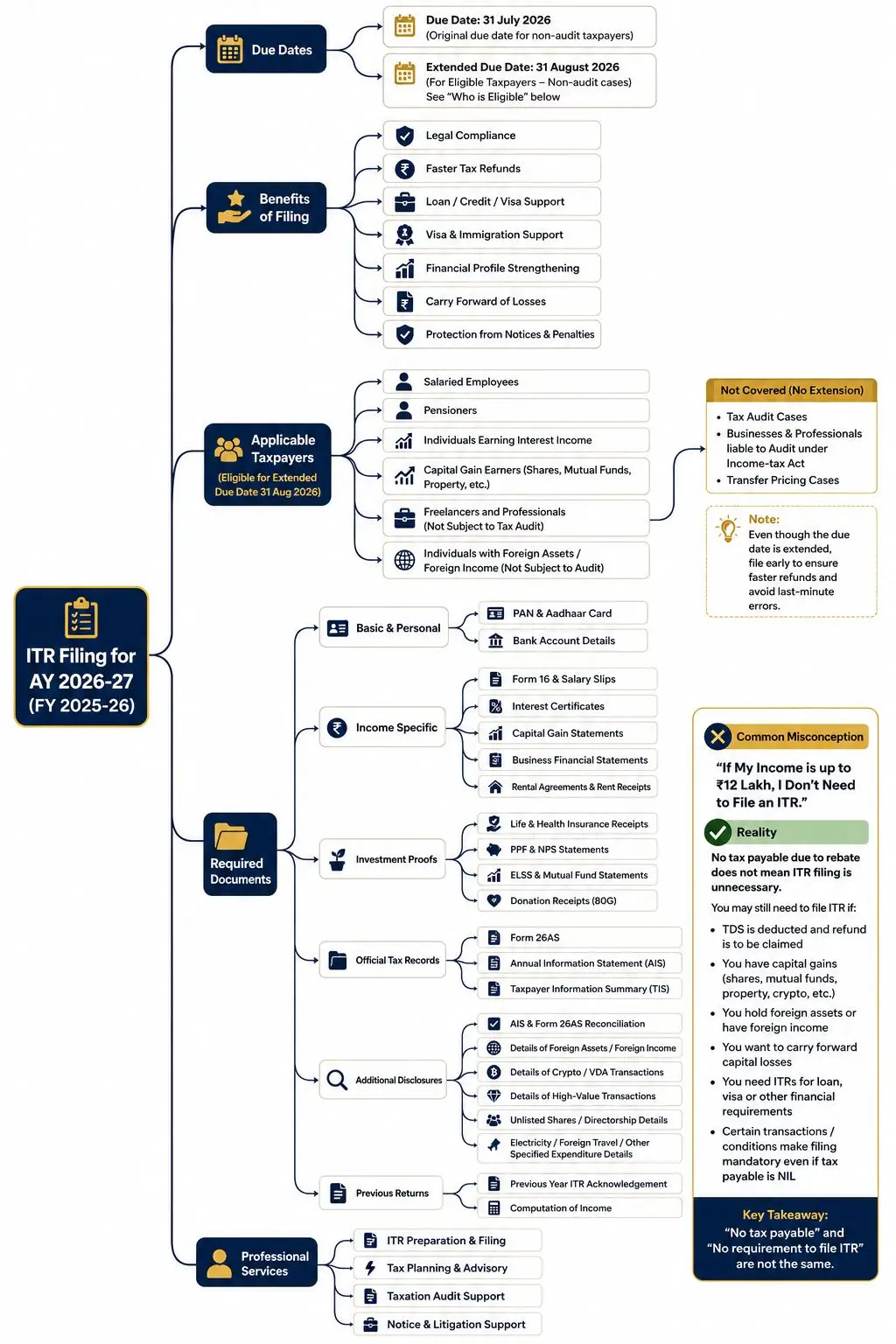
Comprehensive ITR Filing Roadmap for AY 2026-27
Understanding FY 2025-26 and AY 2026-27
| Particulars | Period |
|---|---|
| Financial Year (FY) 2025-26 | 1 April 2025 to 31 March 2026 |
| Assessment Year (AY) 2026-27 | 1 April 2026 to 31 March 2027 |
Who Should File an Income Tax Return?
An Income Tax Return may be mandatory or strategically beneficial for the following categories of taxpayers:
Salaried Employees
Individuals receiving salary income and having taxable income exceeding the prescribed threshold.
Professionals and Freelancers
Individuals earning: Consultancy income, Professional fees, Freelance receipts, Commission income.
Business Owners
Individuals carrying on: Proprietary business, Online business, Trading activities, Professional practice.
Capital Gain Earners
Taxpayers having: Equity transactions, Mutual fund redemptions, Property sales, Cryptocurrency transactions.
Rental Income Recipients
Individuals receiving: Residential rent, Commercial rent, Multiple house property income.
Foreign Asset Holders
Persons holding: Foreign stocks, Overseas bank accounts, ESOPs, Foreign mutual funds, Any financial interest outside India.
Refund Claimants
Individuals seeking refund of: Excess TDS, Advance tax, Self-assessment tax.
Due Dates for Filing ITR for AY 2026-27
Individual Taxpayers (Non-Audit Cases)
Normal Due Date: 31 July 2026
Additional Due Date for AY 2026-27: Extension up to 31 August 2026 for Eligible Taxpayers
The Central Board of Direct Taxes (CBDT) has extended the due date for filing Income Tax Returns for certain non-audit taxpayers from 31 July 2026 to 31 August 2026.
The extended due date generally applies to taxpayers whose returns are required to be filed under the normal due date of 31 July and who are not subject to tax audit under the Income-tax Act. This broadly includes:
- Salaried individuals
- Pensioners
- Individuals earning interest income
- Individuals having capital gains from shares, mutual funds or property transactions
- Freelancers and professionals not liable to tax audit
- Individuals having foreign assets or foreign income but not subject to audit requirements
The extension does not apply to:
- Tax audit cases
- Businesses and professionals liable to audit under the Income-tax Act
- Transfer pricing cases
Tax Audit Cases
Due Date: 31 October 2026
Transfer Pricing Cases
Due Date: 30 November 2026
Why Filing Before the Due Date Matters
Timely filing helps taxpayers:
Why Filing Your ITR is Important
Faster Tax Refunds
Early filing generally results in quicker processing of: TDS refunds, Excess advance tax refunds.
Essential for Loan Applications
Banks routinely seek: ITR acknowledgements, Computation of income, Financial statements while processing: Home loans, Business loans, Personal loans, Credit facilities.
Important for Visa Applications
Several foreign embassies require: ITR acknowledgements for previous years, Income proof, Evidence of financial stability. ITRs frequently play a crucial role in obtaining: Tourist visas, Student visas, Business visas.
Builds Financial Credibility
A properly maintained history of ITR filings establishes: Documented income history, Financial discipline, Better creditworthiness, Stronger financial profile.
Carry Forward of Capital Losses
Timely filing allows taxpayers to carry forward: Short-Term Capital Losses, Long-Term Capital Losses which may subsequently be set off against future gains.
Documents Required for ITR Filing
Compiling the right documentation is crucial for an accurate return. Below is the comprehensive framework for required documents along with the detailed Document Requirements Matrix.
A. Basic Documents
- PAN Card
- Aadhaar Card
- Bank account details
- Mobile number
- Email address
B. Salary Income Documents
- Form 16
- Salary slips
- Form 12BA, wherever applicable
C. Bank & Interest Income
- Savings account statements
- Fixed deposit statements
- Interest certificates
- Recurring deposit statements
D. Capital Gain Documents
- Shares & Mutual Funds: Capital Gain Statement, Profit & Loss Statement, Demat Statement, Broker Transaction Report
- Property Transactions: Sale/Purchase Deed, Stamp Duty Receipts, Improvement Cost Details
- Virtual Digital Assets: Crypto transaction reports & Exchange statements
E. Foreign Asset Documents
- Foreign broker statements
- Dividend statements
- Tax withholding certificates
- Overseas bank statements
- Closing balance reports
F. Deduction Proofs
- Section 80C: LIC, PPF, ELSS, Tuition fees
- Section 80CCD: NPS statements
- Section 80D: Health insurance receipts
- Section 80G: Donation receipts
- Home Loan: Interest & Principal statements
Detailed Document Requirements Matrix
| Category | Required Document | Purpose of Document | Income/Expense Type | Applicable Section |
|---|---|---|---|---|
| Basic Documents | PAN Card | Permanent Account Number of the taxpayer | General Identity | Section 139A |
| Basic Documents | Aadhaar Card | Linked Aadhaar details for verification and authentication | General Identity | Section 139AA |
| Basic Documents | Bank Account Details | Details of all savings and current accounts maintained during FY 2025-26 | General Financials | Section 139 |
| Salary Income Documents | Form 16 | Details of salary, exemptions, deductions and TDS deducted | Salary Income | Section 192 |
| Salary Income Documents | Salary Slips | Monthly slips for reconciliation of income and deductions | Salary Income | Section 15 |
| Salary Income Documents | Form 12BA | Statement of perquisites and benefits provided by employer | Perquisites | Rule 3(7)(ix) |
| Bank and Interest Income Documents | Interest Certificates | Certifying interest from Savings account, Fixed Deposit and Recurring Deposit | Interest Income | Section 56 |
| Investment and Deduction Proofs | Life Insurance Premium Receipts | Claiming deductions for LIC and other eligible life insurance policies | Investment/Insurance Expense | Section 80C |
| Investment and Deduction Proofs | Health Insurance Premium Receipts | Claiming deductions for health insurance premiums | Insurance Expense | Section 80D |
| Investment and Deduction Proofs | PPF Contribution Proofs | Proof of investment in Public Provident Fund | Investment | Section 80C |
| Investment and Deduction Proofs | ELSS Investment Statements | Mutual fund investment proofs eligible for deduction | Investment | Section 80C |
| Investment and Deduction Proofs | Tuition Fee Receipts | Eligible educational expenses paid for children | Education Expense | Section 80C |
| Investment and Deduction Proofs | National Pension System (NPS) Statements | Claiming deductions for NPS contributions | Retirement Investment | Section 80CCD(1) / 80CCD(1B) |
| Investment and Deduction Proofs | Donation Receipts | Claiming deductions for charitable donations | Donations | Section 80G |
| Investment and Deduction Proofs | Disability Certificates | Proof for deductions regarding disability | Medical/Disability Expense | Section 80U / 80DD |
| Home Loan Documents | Interest Certificate from the Bank | Claiming deduction on home loan interest | Interest Expense | Section 24(b) |
| Home Loan Documents | Principal Repayment Details | Claiming deduction on principal repayment of home loan | Loan Repayment | Section 80C |
| Capital Gains Documents | Capital Gains Statement / Broker Reports | Accurate reporting of Short-Term and Long-Term Capital Gains | Capital Gains from Shares/Mutual Funds | Section 45 |
| Tax Summaries | Form 26AS | Verifying TDS, TCS and Advance tax payments | Tax Credits | Section 203AA |
| Tax Summaries | Annual Information Statement (AIS) | Captures interest, dividends and high-value transactions | Multiple Income Sources | Section 285BB |
| Additional Documents Recommended for AY 2026-27 | ||||
| Capital Gains - Property | Purchase Deed, Sale Deed, Stamp Duty Receipts, Cost of Improvement Documents, Brokerage Details | |||
| Virtual Digital Assets (Crypto) | Exchange Statements, Wallet Statements, Transaction Reports, P&L Report, Section 194S TDS details | |||
| Foreign Assets and Foreign Income | Foreign broker statements, overseas bank statements, dividend statements, tax withholding certificates, ESOP statements, closing balance reports | |||
| Tax Credit & Reconciliation | Form 26AS, AIS, TIS, Advance Tax and Self-Assessment Tax challans | |||
| Additional Deduction Proofs | Education loan interest certificate, rent receipts and landlord PAN, donation receipts, EV loan interest certificate | |||
| Other Relevant Documents | High-value transactions, foreign travel expenditure, electricity expenditure, unlisted shares/directorship details, previous year's ITR and computation, refund bank account details | |||
How to Select the Correct ITR Form
ITR-1 (Sahaj)
Applicable where taxpayer has: Salary income, One house property, Interest income, Specified LTCG under section 112A up to prescribed limits, Total income within applicable conditions.
ITR-2
Applicable where taxpayer has: Capital gains, Multiple house properties, Foreign assets, Director in a company, Foreign income.
ITR-3
Applicable where taxpayer has: Business income, Professional income, Trading income, Partnership income.
ITR-4 (Sugam)
Applicable to eligible taxpayers opting for: Presumptive business taxation, Presumptive professional taxation subject to prescribed conditions.
AIS, Form 26AS and TIS Reconciliation
Form 26AS
Contains: TDS details, TCS details, Advance tax payments.
Annual Information Statement (AIS)
Contains information relating to: Interest income, Dividend income, Securities transactions, Foreign remittances, High-value transactions.
Taxpayer Information Summary (TIS)
Provides: Summarised information, Computed values available with the department, Information expected to be reported in the return.
Why Reconciliation is Critical
An omission or mismatch between: Bank statements, Form 26AS, AIS, TIS, Income Tax Return may result in: Defective returns, Refund delays, Verification proceedings, Income mismatch notices.
Common Mistakes to Avoid While Filing ITR
Common Misconception: "If My Income is Up to ₹12 Lakh, I Don't Need to File an ITR"
This is one of the most widely misunderstood aspects of the new tax regime. The fact that an individual may not ultimately pay any income tax due to the rebate provisions does not automatically mean that filing an Income Tax Return is unnecessary.
Basic Exemption Limit for Mandatory ITR Filing
Generally, an individual is required to file an Income Tax Return if their gross total income before claiming deductions and exemptions exceeds the applicable basic exemption limit. The basic exemption limits are:
- Old Tax Regime: ₹2.5 lakh for individuals below 60 years of age.
- New Tax Regime: ₹4 lakh.
However, even if your income is below these limits, filing an ITR may still be mandatory in certain cases or beneficial for claiming refunds and maintaining financial records. You may still be required or strongly advised to file an ITR because:
- TDS may have been deducted and a refund needs to be claimed.
- You have capital gains from shares, mutual funds or property transactions.
- You hold foreign assets or have foreign income.
- You wish to carry forward capital losses to future years.
- You need ITRs for loan applications, visa applications or financial documentation.
Certain specified transactions, such as high-value deposits, foreign travel expenditure or substantial electricity consumption, may trigger mandatory filing requirements even if no tax is ultimately payable.
Step-by-Step Filing Process
- Step 1: Collect all documents.
- Step 2: Download AIS, Form 26AS and TIS.
- Step 3: Reconcile all income and tax credits.
- Step 4: Determine the correct tax regime.
- Step 5: Select the appropriate ITR form.
- Step 6: Compute tax liability.
- Step 7: File the return.
- Step 8: Complete e-verification.
- Step 9: Track refund status.
Frequently Asked Questions (FAQs)
Q1. Is filing mandatory if my income is below the taxable limit?
Not always. However, filing may still be beneficial for refunds, visa applications and building financial credibility.
Q2. Can I claim a refund if TDS has been deducted?
Yes. Filing an Income Tax Return is necessary to claim excess TDS refunds.
Q3. I invested in US stocks. Do I need additional disclosures?
Yes. Foreign investments generally require additional reporting and disclosures.
Q4. Can capital losses be carried forward?
Yes, subject to satisfaction of prescribed conditions and timely filing requirements.
Q5. Is AIS reconciliation necessary?
Absolutely. Reconciliation significantly reduces the risk of notices and refund delays.
Conclusion: An Income Tax Return is no longer merely a statutory filing requirement. It is one of the most important financial documents maintained by an individual. A well-prepared and accurately filed return: Strengthens financial credibility, Facilitates loans and visas, Enables tax refunds, Preserves tax benefits, Minimises litigation risks and Supports long-term financial planning. As the due date of 31 July 2026 approaches, taxpayers should begin collating their documents and reconciling their records well in advance.
About the Author
Anmol Aniket and Associates
We assist individuals, professionals and businesses with:
- Income Tax Return Filing
- Capital Gains Computation
- Foreign Asset Reporting
- Tax Planning and Advisory
- Refund Assistance
- Assessment and Litigation Support
Need Assistance?
Anmol Aniket and Associates provides expert assistance for filing ITR and corporate tax returns.
Our tax compliance team handles salary, business, capital gains, foreign asset disclosures and lower withholding tax applications with absolute accuracy.
CONNECT WITH OUR TEAM